Loading…
8086
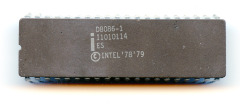
Launched in 1978The Intel 8086 is a 16-bit CISC microprocessor introduced in 1978 and the direct architectural ancestor of the x86 family, combining a 16-bit ALU, 16-bit registers, a 16-bit external data bus, and a 20-bit physical address space for up to 1 MiB of memory via segmented addressing. Its programming model includes AX, BX, CX, DX, SP, BP, SI, DI, the segment registers CS, DS, SS, ES, an instruction pointer, and FLAGS, with physical addresses formed by shifting the segment left four bits and adding the offset. Internally, the 8086 is divided into a Bus Interface Unit and an Execution Unit, allowing limited pipelining through a 6-byte prefetch queue so instruction fetch and execution can partially overlap. It uses a multiplexed address/data bus, supports minimum and maximum bus modes, and introduced core x86 traits such as variable-length instructions, flexible memory addressing, string operations, interrupts, and support for the 8087 coprocessor. Although it lacks protected mode, paging, and on-chip cache, the 8086 defined the compatibility foundation later extended by every major x86 generation.